

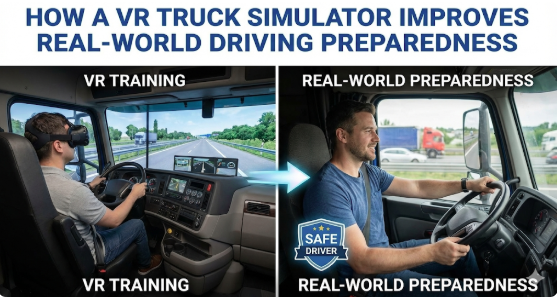
The modernisation of the trucking industry is moving quickly at an accelerating rate, with increasing availability of advanced computerised systems intended to maximise duty safety and productivity. The latest breakthrough in this area, the VR truck simulator, is shown to be an indispensable tool in overcoming one of the more disturbing elements of web-based instruction, the lack of interaction with the learning material.
The driving simulator replicates the driving experience exactly, providing practice in a safe, free of trouble and worry environment, thus giving drivers early access to the truck to be driven experience, while developing the competencies, confidence, self-assurance, and understanding of the perspective of driving which can then be translated to real driving situations.
Due to increasing demands on logistics companies in terms of falling accident rates, fuel costs, and driver training time, immersive, simulation-driven learning is becoming an essential strategic investment. Virtual reality-based truck training is now becoming the new norm for professional drivers.
The Challenge of Traditional Truck Driver Training
Standard truck driver training involves classroom tuition along with limited “hands-on” practice on the road. While this provides good training, it does not always prepare sufficiently for the unpredictable nature of day-to-day driving, such as driving, for instance, in heavy weather, emergency stops, or multi-interaction situations.
Road training is risky. New heavy vehicle drivers may have a road accident, resulting in a damaged vehicle or an increased insurance premium. Costs of fuel and wear and tear on the vehicle, together with the limited scope of driving circumstances, make on-road training costly and time-consuming.
To these realities, the call for more intelligent, safer, and more scalable training has ensued, and hence the rise of immersive simulation technology.
How Virtual Reality Transforms Driver Training
Virtual reality can produce end-user experiences that are just as real as being in a truck; this is impossible in real life, as it would be too dangerous. Precision of virtual reality simulations can replicate truck cabins, truck controls, the road network, traffic conditions, and the environment.
Unlike static learning, VR is more interactive. The drivers are expected to react to the situation according to the demand of the moment, make a decision, and finally experience what the consequences of their decision will be. This type of experiential learning can increase retention of learning as well as decrease reaction time.
Limitations of good design AVRC truck VR simulators also let trainees practice many of the important elements, such as lane changes, parallel and reverse parking, hill starts, night/ emergency driving, which might be hard to practice over and over in the real environment.
Building Confidence Through Repetition and Realism
A key advantage of VR is the ability for the truck drivers to generate “repeatable” scenarios. This will allow drivers to repeat a scenario that they would not want to face in real life.
In virtual environments, we can test drivers in rare, yet lethal, situations, such as a tyre blowout, brake failure, or the sudden appearance of a pedestrian.
Most commercial simulation systems have co-developed the visuals with a 3D visualization company to enable a convincing visual environment, representing all vehicle physics, landscape, and environmental detail. This realistic visual environment develops the muscle memory and situation awareness needed for real vehicles.
Improving Safety and Reducing Accidents
In its role as the first form of transit, safety becomes a primary concern. VR training, being a safe environment, gives drivers the chance to learn from their mistakes, to develop, and then to succeed, without putting operators or hardware at risk. Trainers can see how drivers deal with the training, identify a lack of skills, and tutor through performance data.
Furthermore, sheltering can give a safer condition for damage attenuation and potential hazard perception skills. Once a simulation- related environment happened within a virtual world, users could have a feeling that they could smoothly predict hazards and be ready for “what if ” circumstances that are closer to their real life. It is helpful to improve the driver’s attention and reflexes for contingency in the driving situation. Studies have also found that virtual models could greatly reduce crash and injury risk for model-based processes.
Thus, for fleet owners, it translates into lower insurance premiums, and better regulatory compliance.
Cost-Effective and Scalable Training Solution
While the investment for the setup of virtual training systems seems to be enormous, when considering the long-term benefits, it is very cost-effective. The expenditure on reducing fuel consumption, vehicle maintenance, and the ongoing watchful eye on the road can be significantly decreased with VR-based training.
Multiple drivers can be trained simultaneously with the same modules. The training can be scheduled independently of the weather, the availability of the vehicle, and other drivers.
For multi-location companies, this kind of training gives consistency, ease of use, and quality that traditional ways cannot support.
Readying Drivers for Tomorrow‘s Transportation
As advanced driver assistance systems, autonomous, and intelligent logistics become more widespread, drivers will have to become used to even more complex vehicle technologies. They will have to be virtual environments that are stable to update with new vehicles, laws, and roads.
The concept of the VR truck simulator is the foremost step toward further training of safer drivers and preparing the driver for more realistic road conditions of the future. This union of knowledge and technology includes it as an integral part of the trucking industry and the future of transportation.
Conclusion
With the tremendous advancement in size, scale, and scope of the transportation industry, the importance of training drivers for a wide range of situations cannot be overstated. A cost-effective VR truck simulator, instructor-led immersive simulation, offers an attractive solution that enhances driver training while covering the shortcomings and potential risks of conventional approaches. Driver training can be enhanced by hands-on simulation, decision-making, and a substantial reduction in training cost.