
As design projects are growing in size and complexity, flexibility is as important as visual quality. Static visuals often lag when it comes to changes, revisions, and multi-platform requirements.
This is where a 3D vector map comes in. Unlike raster-based forms of visuals, vector-oriented maps are scalable, configurable, and evolving without losing clarity.
Many teams working with an architectural visualization company in India are now adopting 3D vector maps as a core component of their digital design workflows.
Infinite Scalability Without Quality Loss
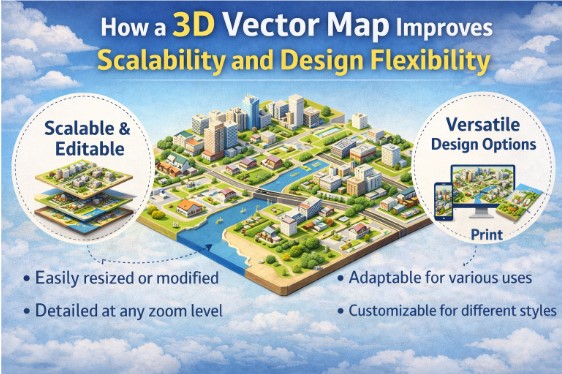
The biggest asset of a 3D vector map is its scalability. A vector map is free from fixed resolution, so it can zoom in and out infinitely without being pixelated. The quality remains sharp whether the application is for a city-wide master plan or a more focused neighborhood study.
This makes the 3D vector format good for wider applications, including large screen formats, print, presentation, and digital platforms, without resetting the asset.
Easier Design Modifications and Updates
Changes to the design become rarer to be witnessed as the final. Roads change, zones shift, and new phases get added. With raster visuals, even small updates imply lots of reworking. The 3D vector map enables designers to work quite efficiently with changes to buildings, pathways, labels, or terrain.
Because objects are built as editable vectors, changes are cleaner and faster. This flexible approach carries its own value during lengthy projects run by an architectural visualization company in India because changes are in the routine, not exceptions.
Consistent Visual Language Across Assets
Getting visual consistency across various deliverables is challenging. The role of a 3D vector map is to work as a solution for this task by employing a unified design system.
This allows consistency in color, line weight, shape, and symbol regardless of how the map is used or resized. Such consistency supports brand recognition while enhancing readability when visuals are applied across teams, clients, or public platforms.
Smooth Integration Across Digital Platforms
The demands of modern design workflows have to be met with assets that work everywhere: websites, mobile applications, dashboards, pitch decks, and interactive tools.
A 3D vector map finds its way smoothly into these capabilities. A faster load, smooth integration with interactive layers, and better performance across devices make it a choice for digital-first projects where performance and responsiveness matter.
Better Control Over Design Layers
Complex location-based visuals involve multiple layers of controlling information. Current roads, buildings, utilities, green spaces, and future developments need to coexist without saturating the viewer. A 3D vector map allows designers to give independent control to these layers.
The elements can be shown, hidden, highlighted, and simplified depending on the audience. This control creates clarity and allows the same base map to serve multiple purposes.
Improved Collaboration Between Teams
When assets are flexible and easy to update, collaboration improves. Designers, planners, developers, and stakeholders can set to work on one base map without there being version conflicts.
Vector-based maps bring so much less resistance since updates are themselves cleaner and more predictable. To these teams communicating with an architectural visualization company in India, this shared flexibility lubricates approvals and visuals, keeping everyone aligned.
Long-Term Cost and Time Efficiency
Though the making of a 3D vector map requires skills and planning at the beginning, it pays off eventually in the long run. The same asset can be reused, adapted, and extended across the multiple phases of a project.
Instead of the whole series of visuals being newly designed from scratch, it’s that existing maps, along with some refinements and enhancements, are the ones being worked on.
This means shortening production time in turn saving costs and keeping the quality of design uniform throughout the lifetime of the project.
Supporting Future Expansion and Interactivity
Design assets often need to support interactivity or data-driven features, while projects undergo significant changes. 3D vector maps happen to fit this need.
They easily connect with real-time data, animation, or user interaction while maintaining their solidity. This makes them future-ready, especially on smart city, infrastructure planning, and digital twin project fronts.
Conclusion
Design flexibility and scalability cannot be considered optional in contemporary workflows. A 3D vector map provides both, allowing visuals to conform as projects expand and change.
The ability to be infinitely upscale while also providing fast updates and easy integration across platforms constitutes a stronghold for long-term design success.
3D vector maps, for teams working with an architectural visualization company in India, provide the needed bedrock, engender clarity today, and offer flexibility for anything in the near future.